


How to Plan Your Brand Strategy: A Quarterly Reset

This blog is dedicated to helping you make sense of all those fluffy marketing terms you hear on Instagram and figure out what they actually mean for your business. Step-by-step guides, platform breakdowns, client case studies, and deep dives into the stuff that actually helps you grow.
XO Catie
At the end of a quarter, I pull out my paper planner, scroll through my camera roll, and open Notion to remind myself what I actually did. There are always wins I’ve forgotten about—and a few things that took more time than I realized.
When you’re busy running your business, it’s easy to move from one project, launch, or client to the next without stopping to ask what’s working—or whether it’s still moving you toward the business you want.
That’s where a quarterly brand reset comes in. It’s my simple approach to brand planning: a chance to look back at what happened, notice what’s changed, and decide what deserves your attention over the next 12 weeks.
Not a rebrand. Not rewriting your mission and vision every few months. And definitely not a perfectly color-coded plan that ignores the time you actually have.
Just a way to step back, use what you’ve learned, and make a few decisions that connect your day-to-day work to the bigger picture. Here’s how I do it for my own brand and my clients—and how you can try it for yours.
Why I stopped doing monthly brand recaps
When I started beta testing my Brand Bestie mentorship and management offers in 2024, I wanted two things: to be able to separate the work I was doing from my clients’ results, and to see how that work was paying off—even when it didn’t look like it right away.
Because most brand growth doesn’t happen overnight. Most of us don’t start a brand and go viral. Even with a team, the work you’re doing now takes time to compound.
So I tried a monthly brand snapshot. For myself and my clients.
And honestly? It was too much work. Worse, I couldn’t see much growth month to month—so instead of helping, it mostly discouraged me. One month is just not enough time for most brand work to show up in the numbers.
That’s why I switched to quarterly resets. Twelve weeks gives me enough time to see what’s working, then step back and ask: Is this still moving me toward the business—and life—I want? From there, I can decide what to keep, what to change, and what actually fits my capacity for the next twelve weeks.
And the reset at the end of Q4? That one does double duty. It’s your last quarterly check-in and the foundation for planning next year.
How to plan your brand strategy with a quarterly reset
Here’s the process I use for myself and my 1:1 clients.
And if you’d like some company as you work through your own reset, join me for the free Year-End Brand Reset on Wednesday, December 16, from 1:30–3:30 PM EST on Zoom. I recommend reflecting and gathering your data and content before we meet, but it’s not required. We’ll work through the reset together and create working drafts of a year-end report and a Q1 strategy that fits your real life.
Sign up for the free workshop →
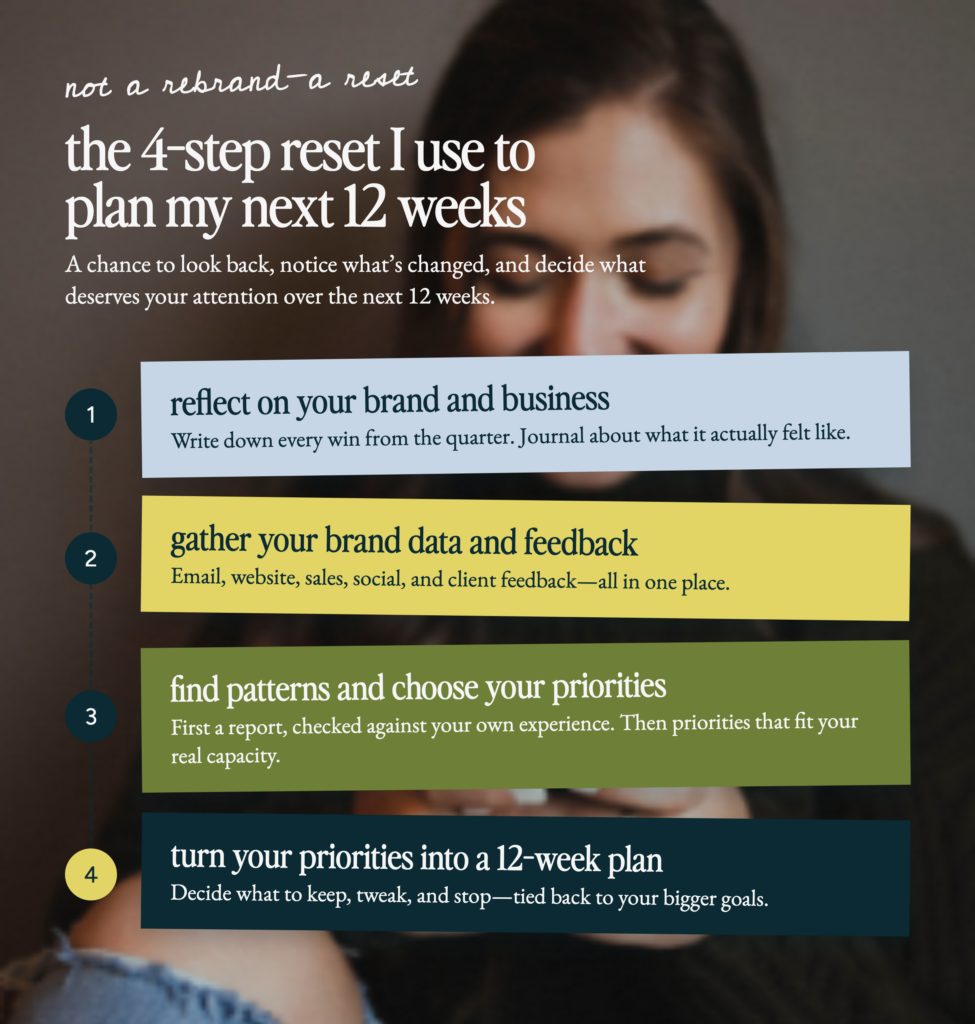
Step 1: Reflect on your brand and business
This is a “dreamspace” task. Good coffee, quiet, alone.
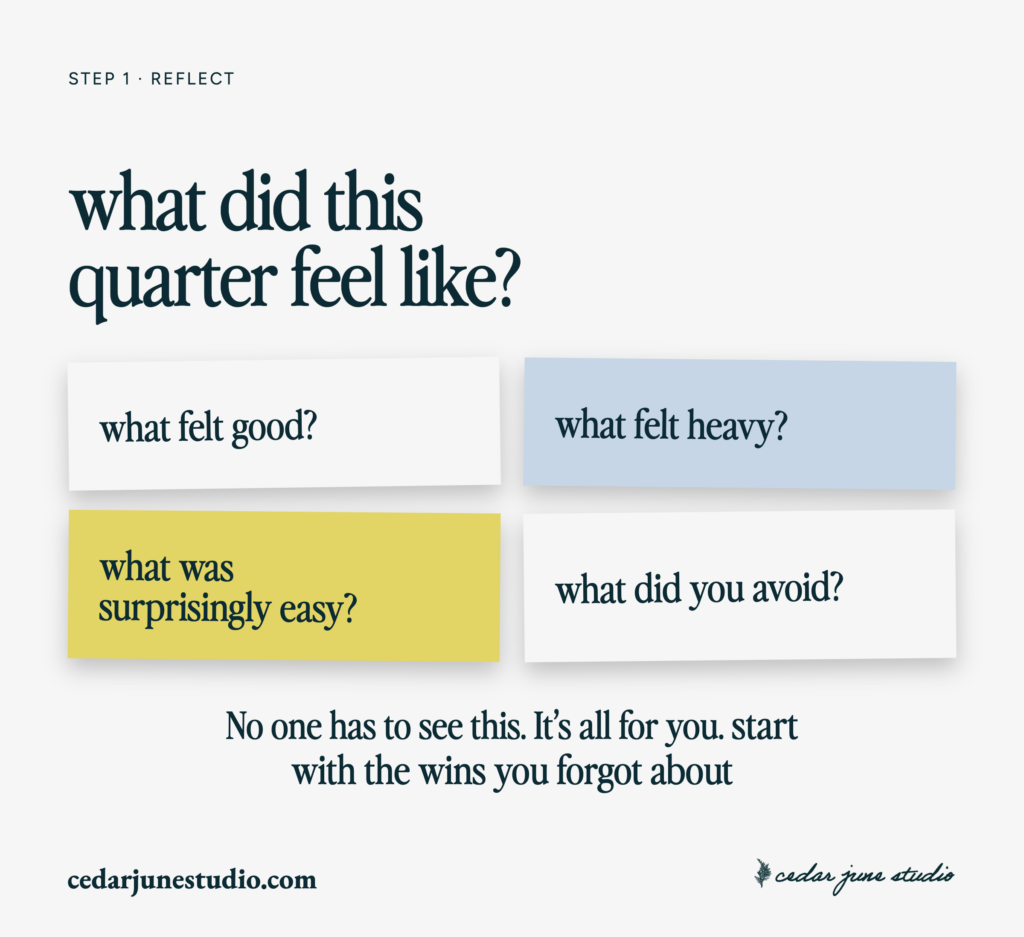
I pull out my paper planner, scroll through my camera roll, and look back through Notion—my calendar, my content, my done list—and write down every win from the quarter. Big ones, small ones, the ones I forgot about until I saw a photo of them.
Since this is the end of the year, zoom out a little further, too. Look at the goals you set for your brand this year and check in on how far you got.
Then journal about what it actually felt like to run your brand this quarter. What felt good? What felt heavy? What was surprisingly easy? What did you avoid?
No one has to see this. It’s all for you.
Step 2: Gather your brand data and feedback
A day or so later, block another session—this time you’re collecting data.
Pull the analytics that matter for your brand: email, website, sales, social, and any feedback you received from clients or customers. If you launched something this quarter and did a retrospective, include that too.
Then pull your best-performing content into one master doc, with titles and publish dates. You’re not analyzing anything yet—you’re just putting everything in one place.
If you want a closer look at what to review, my post on how to measure brand growth works like a brand audit checklist for this step.
Step 3: Find patterns and choose your priorities
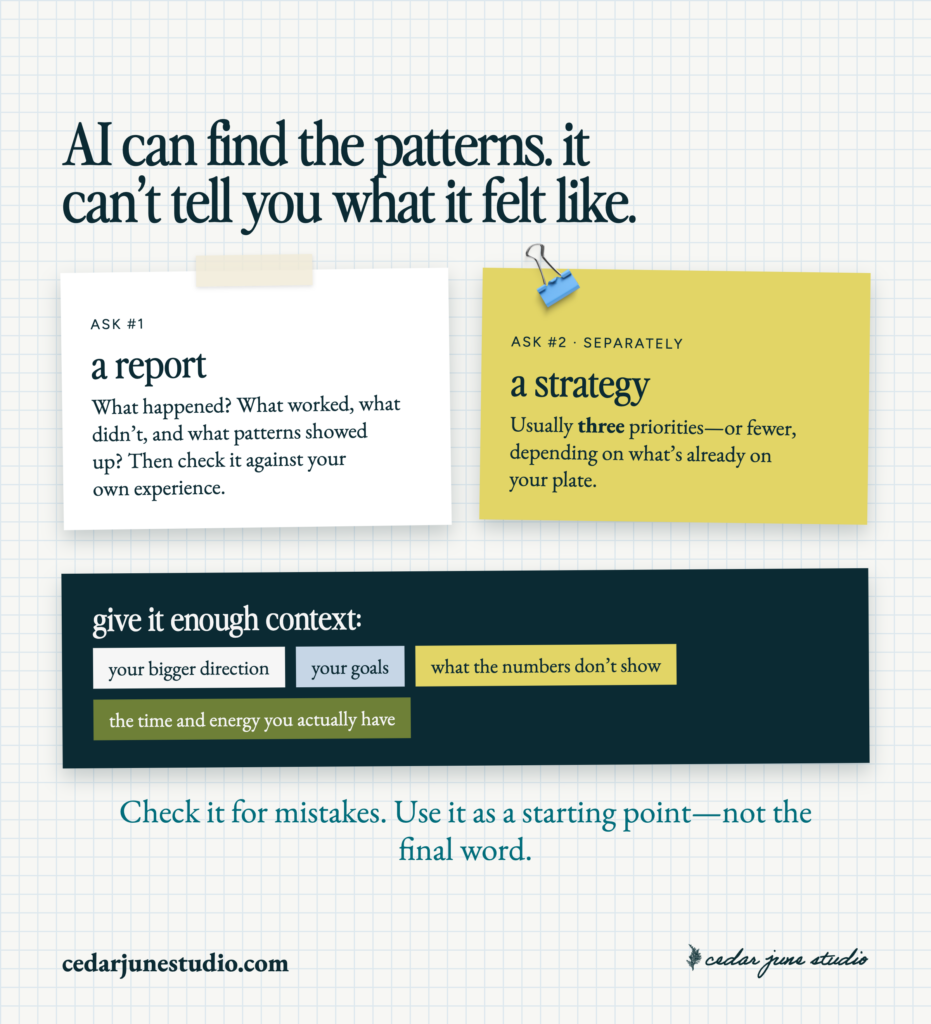
This is where I bring in AI. It helps me organize what I’ve gathered and notice patterns I might have missed. But it doesn’t know what it felt like to do the work, what I want more of, or what I have room for next. That part still comes from me.
First, I ask for a report: What happened? What worked, what didn’t, and what patterns showed up? Then I check it against my own experience. Something might look successful in the numbers but have taken more time or energy than I want to spend on it again. Both things matter.
During my midyear reset, for example, I noticed that my Studio Session page was getting attention—but my three most recent Studio Session clients had come through referrals. That helped me look beyond “post more” and think about the relationships and audience I already had, as well as where my website might need to do a better job.
Before I decide what to focus on next, I zoom out: What am I building toward? What do I want more room for—in my business and in my life? The answers don’t have to be perfectly clear. They just give the next few months a direction.
Then, separately, I ask for strategy. But not a 15-point plan. I usually ask for three priorities because that’s a useful limit for me. You might choose fewer, depending on what’s already on your plate. “Make me a brand strategy for the whole year” can spit out something so long and generic that it overwhelms you before you even start.
Give AI enough context: your bigger direction, your goals, what the numbers don’t show, and the time and energy you actually have. Check the report for mistakes, and use its suggestions as a starting point—not the final word.
Choosing what to work on this quarter doesn’t mean the rest of your ideas disappear. Give them somewhere to live—and permission to wait until you have the time, energy, or information to come back to them.
Step 4: Turn your priorities into a 12-week brand plan
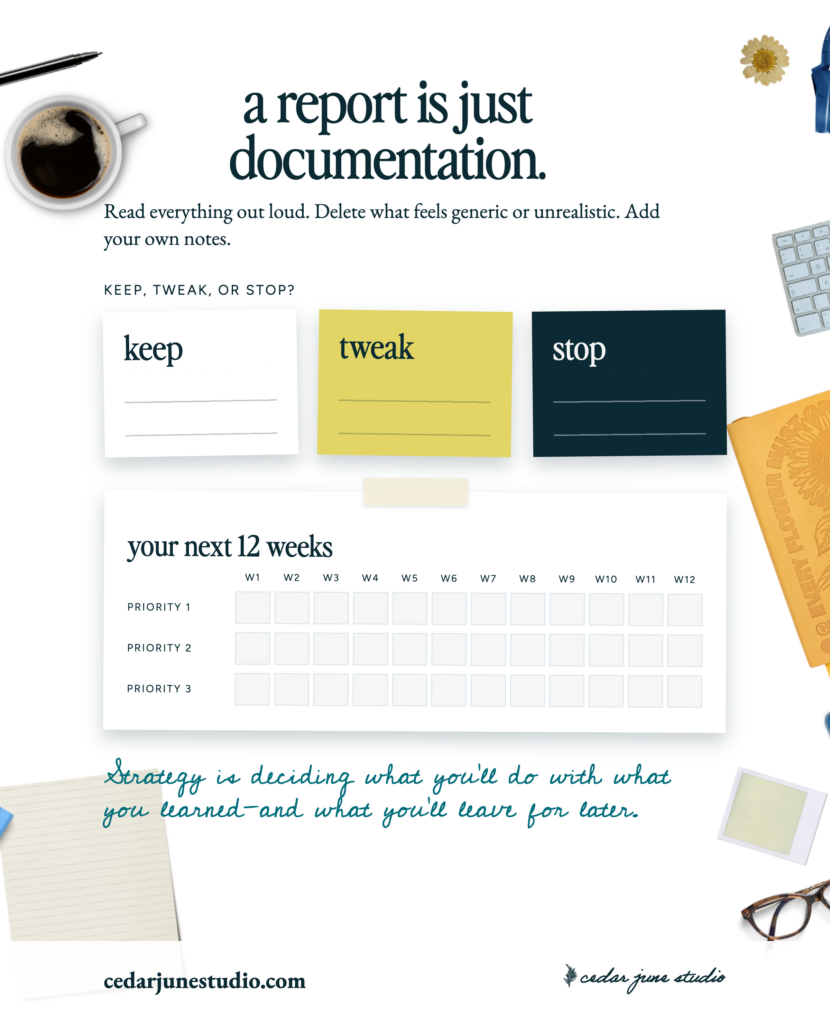
Then come back and read everything out loud. Delete what feels generic or unrealistic. Add your own notes. Decide what you’re going to keep, tweak, and stop.
This is the step I was missing when I first started doing resets: a report is just documentation. Strategy is deciding what you’ll do with what you learned—and what you’ll leave for later. The reset ends by turning your priorities into a realistic plan for the next 12 weeks, tied back to the bigger picture.
How to keep your brand strategy moving between resets
A quarterly reset is only useful if it actually shows up in your day-to-day. Here’s what that looks like for me right now. (It looked different a year ago, and it will probably look different again a year from now.)
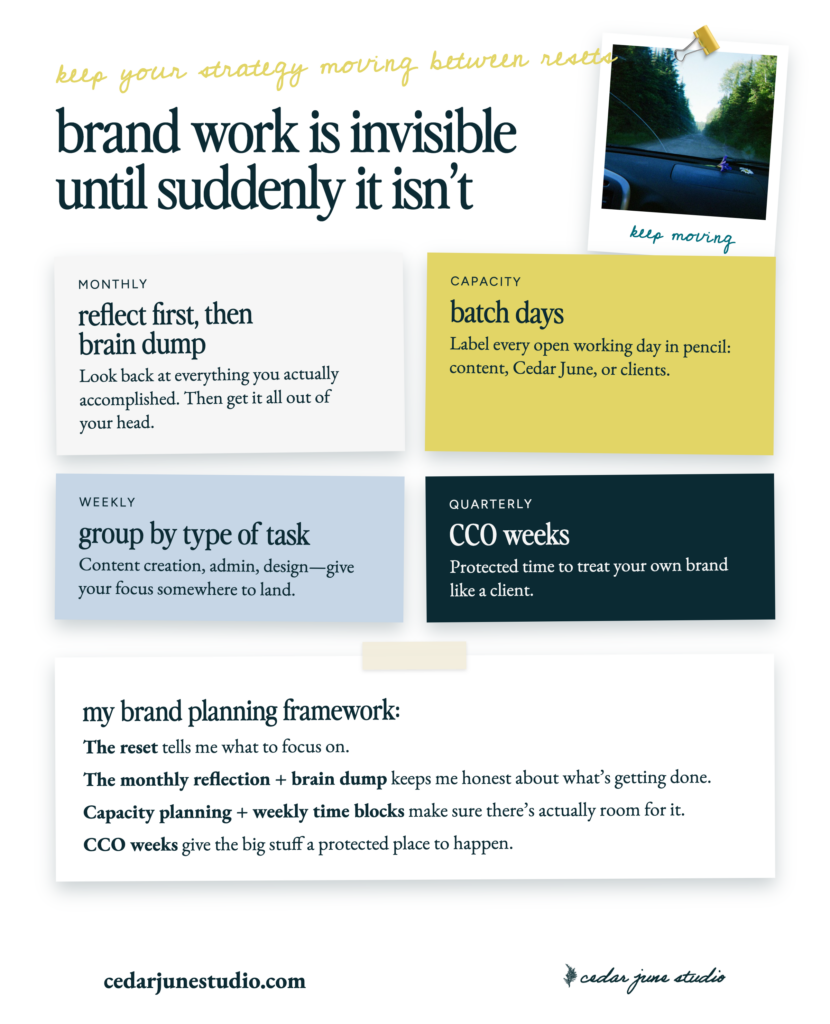
Monthly: reflect first, then brain dump
I no longer track my time down to the minute or fill out a monthly snapshot. Instead, at the end of every month, I do a smaller version of Step 1: I look through my paper planner, my camera roll, and Notion to see everything I actually accomplished.
This is my go-to practice. Brand work is mostly invisible until suddenly it isn’t—and looking back is how I remember that I am making progress, even when nothing feels “finished.”
Then I brain dump. It’s usually a mix of journaling and Notion: everything floating around in my head goes somewhere I can see it, and then I sort it into what actually belongs in the coming month.
Lately, my monthly planning has looked a lot like Maia Ben Aïm’s monthly planning guide. She breaks her vision into years → quarters → months → weeks → days, groups tasks into focus projects, and plans around her capacity. Her guide reminded me that planning gets so much easier when you stop trying to do everything at the same time.
Capacity: batch days
I use a hybrid of batch days and capacity planning. When I look at the quarter ahead, I go through every open working day and label it in pencil in my paper planner: content, Cedar June, or clients.
That shows me how much availability I really have—and which offers I can actually book and deliver this quarter.
Weekly: group by type of task
Week to week, I organize my days by the kind of work I’m doing—content creation, admin, design—or at least split mornings and afternoons, then time block in Notion Calendar. Grouping similar work together gives my focus somewhere to land.
Quarterly: CCO weeks
And once a quarter, I take a CCO (Chief Creative Officer) week—protected time to treat my own brand like a client. This is where the priorities from my reset actually get worked on, instead of getting squeezed in around everyone else’s projects.
Put all together, this is the brand planning framework I use right now:
- The reset tells me what to focus on.
- The monthly reflection and brain dump keeps me honest about what’s getting done.
- Capacity planning and weekly time blocks make sure there’s actually room for it.
- CCO weeks give the big stuff a protected place to happen.
And all of those pieces work better when they connect back to the bigger picture: where you want your brand—and your life—to go over the next few years. Your next 12 weeks don’t have to accomplish everything. They just need to move you in a direction that still feels right.
From looking back to moving forward
A reset isn’t about planning every detail of the next year. To me, this is what slow branding looks like in practice. It’s about looking back at what you’ve learned, remembering what you’re building toward, and making a few thoughtful decisions for right now.
Some things are worth keeping. Some might need to change, be tested, or wait for another season. And when life changes the plan, you can come back to it. That doesn’t mean the planning was a waste of time.
The reset is where I look at where I’ve been and where I want to go. I’m building the Brand Roadmap as a place to keep connecting that bigger picture to the work I make time for throughout the year. Join the Brand Roadmap waitlist to follow along as it takes shape.
Your next step
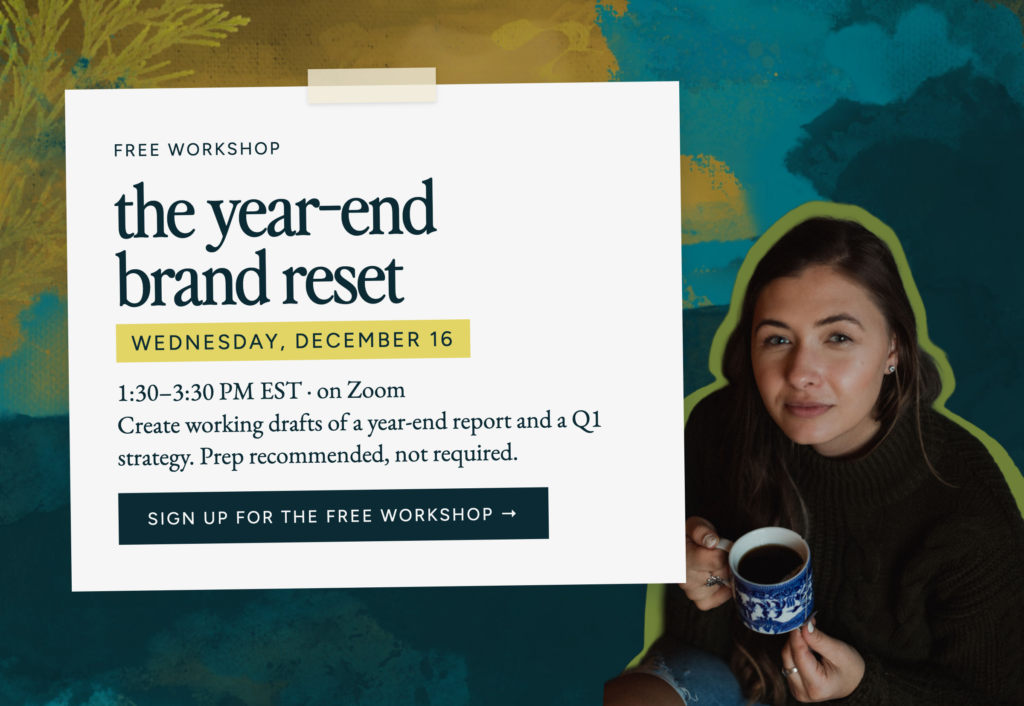
If you want to start planning 2027 with real information instead of a vague feeling, come join me for the free Year-End Brand Reset on Wednesday, December 16, from 1:30–3:30 PM EST on Zoom.
Before we meet, I’ll share Brand Roadmap resources to help you reflect on your year and gather the goals, data, feedback, or content you’d like to bring. Prep is recommended, not required—come with what you have.
In the workshop, we’ll check in on your goals and look for patterns. You’ll create working drafts of a year-end report and a Q1 strategy grounded in your bigger vision and the capacity you actually have.
You don’t need to have everything figured out before you show up. You can keep refining your report and strategy after we meet.
Sign up for the free workshop →
You may also like
November 28, 2026


behind the brand
Behind The Brand is a weekly newsletter for solopreneurs and small business owners navigating the ongoing reality that their brand needs to evolve—whether they’re working with a DIY setup, in the middle of a rebrand, or maintaining an established brand through business pivots.
whether you're working with a DIY setup, in the middle of a rebrand, or managing an established brand through business pivots. If you love learning about the why behind brand design and want practical, actionable strategies to help you own your personal brand and feel confident marketing it—because you understand not just the what, but the how and why—then this is for you.


The Cedar June Brand Color Kit
PDF guide, canva template & tutorial
your brand.
2d Design Masterclass
learn the design basics that will help you make the most of your brand id & save time in canva
your brand.


Chief Creative Officer Week FREE framework
get more done for your brand in 5 days than you have in the last 5 months
Whether you're launching, rebranding, pivoting, or just ready to finally love your brand—here's how we can create something that celebrates who you really are while strategically growing your business.

Not sure where to start?
Book a disco call (that’s discovery call, but more fun) and we’ll figure out what makes sense for where you are right now.


Studio Sessions: WEEK LONG REBRAND STRATEGY SPRINTS
Perfect when you need strategic guidance on what's next. Sometimes you just need to brain-dump your brand overwhelm with someone who gets it. In 60 minutes, we'll tackle whatever brand challenge is top of mind—from website strategy to visual direction to figuring out your next pivot. You'll walk away with a clear strategy and the confidence to move forward.

Brand Brushstrokes: Custom Brand Identity + Illustrations

For when you’re ready to show up as your whole, multifaceted self. Stop second-guessing every design decision and get a comprehensive brand package that marries your personal and professional sides. Through custom illustrations and strategic brand development, we’ll create a one-of-a-kind, instantly recognizable brand and the guidelines you need to actually use it.


The Signature Site: Custom Website Design Through Visual Storytelling
When your business has outgrown your website. This done-for-you website design takes you from strategy through site launch. Together we build a website that screams you—where the visual story works with your copy and content, creating a site so aligned it’s like you put your signature on it.
Brand & web design services
BRAND COLOR KIT
BRAND & DESIGN BASICS
BRAND IDENTITY
ILLUSTRATIONS & ICONS
BRAND PIVOT STRATEGY
WEBSITE & SALES PAGE DESIGN

