


How to Measure Brand Growth: A Simple Framework for Creative Business Owners

This blog is dedicated to helping you make sense of all those fluffy marketing terms you hear on Instagram and figure out what they actually mean for your business. Step-by-step guides, platform breakdowns, client case studies, and deep dives into the stuff that actually helps you grow.
XO Catie
You’re creating content, serving clients, sending emails, working on the website. Crossing things off the list and adding three more things to it. You’ve been plugging away at building, or pivoting your brand – but sometimes it feels like you aren’t making any progress. If you’re wondering how to measure brand growth beyond how busy you feel, this is where a quarterly brand reset comes in.
Being inside your brand every day gives you a very particular view of it. You know how much work you’re doing. You know how it feels. But that isn’t the same as knowing how it’s performing—or seeing how far it has grown.
A quarterly brand audit helps you separate your perception from the reality behind your brand—so you can recognize progress, understand what’s working, and carry that evidence into your next season with more clarity. So you are working smarter, not harder – and without burning out in the process.
The short version: Look at your audience, your content, and your impact. Compare what you thought with what actually happened, save a record of your progress, and use what you learn to decide what deserves your attention next.
Why I started reviewing my brand quarterly
During the early rounds of my Brand Bestie mentorship and management offers in 2024, I realized I needed a better way to separate the work I was doing from my clients’ results.
I wanted to see how the strategies we were implementing were paying off—even when it didn’t immediately seem like they were.
And honestly, I needed that perspective for my own brand, too.
I craved a sustainable way to track progress, understand what was working and what wasn’t, and know how to adjust our aim over time.
First, I tried a monthly brand recap.
It was way too much work. And I didn’t feel like I was learning enough from it to justify the time. Month to month – it was hard to see the growth.
At the end of 2025, I switched to a Quarterly Brand Reset model. Since then, I’ve learned so, so, SO much—and the Quarterly Brand Reset model has become an integral part of how I grow my brand, and manage brands 1:1.
What a brand reset is—and what it isn’t
For this kind of audit, you’re not starting with the assumption that something isn’t working.
Maybe things are working. Maybe you’re booked out. Maybe you’re on cruise control and not launching anything new right now.
You can still learn a lot, and lead your brand with more intention – by grounding yourself in the data once a quarter.
A quarterly brand reset gives you a record of:
- What you worked on.
- What changed.
- What your audience and clients responded to.
- What contributed to your goals.
- What needs more time before you can reasonably evaluate it.
And you don’t need a perfectly maintained dashboard to begin.
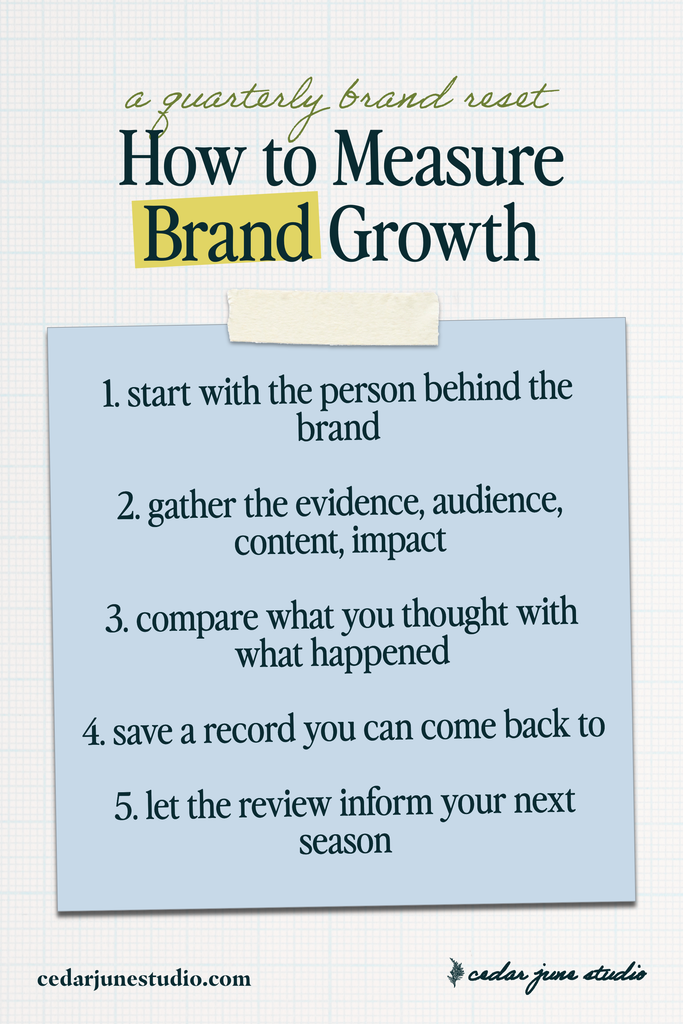
1. Start with the person behind the brand
Before you open your analytics, capture your experience of the quarter.
- How do you think it went?
- What felt good?
- What felt heavy?
- What felt surprisingly easy?
- What did you avoid?
I like to think of this as a “dreamspace” task. Something you want to do alone, with good vibes, & a hot coffee.
Grab your calendar, planner, journal, or a blank document. Your camera roll can be surprisingly helpful, too.
Start by making a list of your wins. Everything you finished, launched, improved, or maintained. Anything you feel proud of looking back and seeing it crossed off as done.
Then check in with your goals:
- What did I make progress on?
- What took more energy than I expected?
- What do I believe is working—and why?
- How much time did I actually have to work on my brand?
These are jumping-off points, not another assignment you need to complete perfectly. You don’t even have to answer them all.
The point is to record your perspective before the numbers start shaping it.
2. How to measure brand growth: Gather the evidence behind your brand
In your next time block, collect the information that helps you understand what happened.
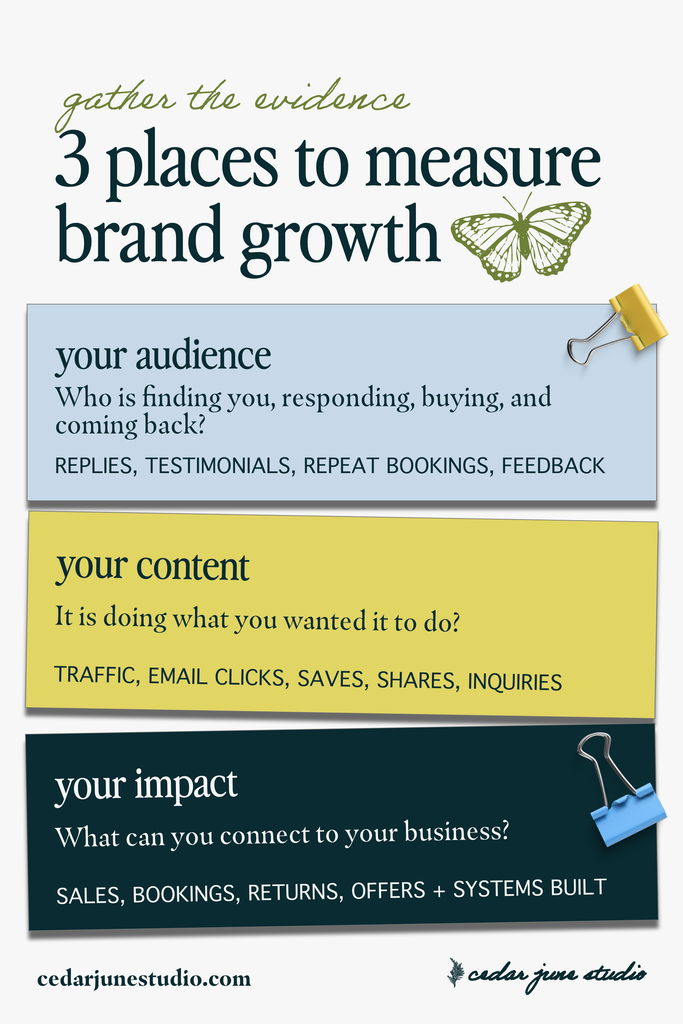
I organize the brand growth metrics and feedback I collect around three areas: your audience, your content, and your impact.
Your audience
Who is finding you, responding, buying, and coming back?
Look at audience growth, email replies, client questions, testimonials, repeat bookings, and feedback.
Pay attention to the language people use.
- What do they describe as valuable?
- What do they ask for?
- What do they tell you made working with you different?
How to know if your content is working
Look at your website, emails, and the platforms where you actually publish.
Gather the content marketing metrics that relate to what you wanted that content to do: website traffic, traffic sources, email clicks, saves, shares, replies, or inquiries.
Pull your strongest pieces into one document, with titles, links, and publishing dates. That makes it easier to compare the content with the results instead of trying to remember what you posted three months ago.
Your impact
Connect the activity to your business.
What sold? Which services were booked? What did people return for? Which efforts can you connect to inquiries or purchases—and where is that connection still unclear?
Include the work behind the scenes, too. An offer developed, a system built, or a website finally launched belongs in your record of progress, even if its full impact isn’t visible yet.
Collect what applies to your brand. You don’t need every metric available just because someone gave you the option to download it.
3. Compare what you thought with what actually happened
Now bring your reflection and your evidence into the same view.
Where do they agree? Where do they tell different stories?
Maybe you felt like you didn’t accomplish much, but your Done List tells you otherwise.
Maybe a piece of content felt unsuccessful because it didn’t get much engagement, but it generated replies or inquiries.
Or maybe something you felt excited about wasn’t what your paying clients were asking for.
That last distinction came up with my client Summer, an esthetician who wanted to bring more of a seasonal, restorative experience into her offers.
We looked at her sales, repeat bookings, website and email performance, and what her clients were already buying and returning for.
Her paying clients valued visible results, expert guidance, and restoration—but they didn’t necessarily want those things packaged as a separate spiritual offer.
The takeaway wasn’t to abandon everything she wanted to bring into her brand. It was to explore how those elements could strengthen the services people already valued.
That’s what you’re looking for: a more informed interpretation, not a number that tells you exactly what to do.
Ask yourself:
- What confirms my impression?
- What challenges it?
- What is still too early to evaluate?
- What can’t I determine from the information I have?
- Am I accounting for my capacity, a launch, or a seasonal shift?
Your experience matters. So do the results. Neither tells the whole story on its own.
4. Save a record you can come back to
Don’t let the audit disappear into a document you never open again.
Save a consistent summary each quarter:
- Your goals and the strategies you were implementing.
- Relevant numbers.
- Completed work and milestones.
- Audience and client feedback.
- Lessons, open questions, and decisions.
The first review gives you a baseline. Repeating it gives you a history.
The point isn’t to prove that every number went up. It’s to understand how your brand is changing—and what the work you’re putting into it is contributing to.
It also gives you somewhere to look the next time you feel like you haven’t gotten anything done.
Because sometimes you don’t need a new productivity system.
You need to remember what you already did.
5. Let the review inform your next season
Only now do we move into planning.
Not “How do I create a completely new strategy?”
More like:
Knowing what I know now, what deserves my attention next?
You might continue something that needs more time. Deepen a strategy that’s producing useful results. Adjust how you execute the plan. Stop something that no longer supports your goals. Or test a question you still don’t have an answer to.
Sometimes the most valuable decision is to keep going—with a better understanding of why. That’s part of an intentional brand strategy, too.
Choose a few priorities, connect them to your Brand Missions, and look at your actual calendar.
Not the imaginary calendar where you have unlimited energy and no client work.
The one you’re going to live.
Then sleep on it. Walk away, come back, and delete anything that feels unrealistic or generic. Keep this realistic for one human.[1]
Frequently asked questions about measuring brand growth
How do I measure brand growth for a small business?
Start with your audience, your content, and your impact. Gather the information that connects to your goals, compare it with what you thought happened, and save a consistent summary. For a small business, brand tracking doesn’t need to mean downloading every metric available.
What are the most important brand growth metrics?
The most useful brand performance metrics depend on what you wanted your brand to do. Look at audience growth and feedback, relevant content metrics, inquiries, bookings, sales, and repeat purchases. Include the work behind the scenes, too—even when its full impact isn’t visible yet.
How do I know if my content marketing is working?
Start with what you wanted that content to do. That’s a better way to measure content marketing success than judging it on engagement alone. Look at clicks, saves, shares, replies, and inquiries, and connect those signals to bookings or sales where you can. Where the connection is still unclear, record the question instead of forcing a conclusion.
How long does it take to see brand growth?
Some work needs more time before you can reasonably evaluate it. That’s part of why I use a quarterly review instead of judging everything month to month. Your first review gives you a baseline. Repeating it gives you a history—not a promise that every number will go up.
Should I track followers, likes, and views?
If they relate to your goals, include them. Just don’t make them the whole picture. Compare them with what people do next: reply, click, inquire, buy, or come back.
How often should I review my brand metrics?
For this broader brand review, I use a quarterly rhythm. Monthly recaps were too much maintenance for the insight I was getting. That doesn’t replace closer monitoring of finances, active launches, or anything else that needs ongoing attention.
Make room to notice what the work is doing
What you do with your brand after you launch matters.
What you do after a couple of months, or years. How it grows with you. How you learn from it and let it evolve.
You don’t need to monitor everything every day. But creating a repeatable practice for stepping back helps you see more than whatever happened this week.
Reflect. Gather the evidence. Look for patterns. Record what you learned.
Then take that perspective into your next season.
If you want a home for that practice, the Brand Roadmap connects your Brand Missions, launches, time off, and quarterly reflection in one planning system—so the review doesn’t live separately from what you decide to do next.
And if you’ve gathered the information but want another set of eyes on what it means, a Studio Session gives us space to look at it together and turn those takeaways into a strategy for the season you’re in.
October 16, 2026


behind the brand
Behind The Brand is a weekly newsletter for solopreneurs and small business owners navigating the ongoing reality that their brand needs to evolve—whether they’re working with a DIY setup, in the middle of a rebrand, or maintaining an established brand through business pivots.
whether you're working with a DIY setup, in the middle of a rebrand, or managing an established brand through business pivots. If you love learning about the why behind brand design and want practical, actionable strategies to help you own your personal brand and feel confident marketing it—because you understand not just the what, but the how and why—then this is for you.


The Cedar June Brand Color Kit
PDF guide, canva template & tutorial
your brand.
2d Design Masterclass
learn the design basics that will help you make the most of your brand id & save time in canva
your brand.


Chief Creative Officer Week FREE framework
get more done for your brand in 5 days than you have in the last 5 months
Whether you're launching, rebranding, pivoting, or just ready to finally love your brand—here's how we can create something that celebrates who you really are while strategically growing your business.

Not sure where to start?
Book a disco call (that’s discovery call, but more fun) and we’ll figure out what makes sense for where you are right now.


Studio Sessions: WEEK LONG REBRAND STRATEGY SPRINTS
Perfect when you need strategic guidance on what's next. Sometimes you just need to brain-dump your brand overwhelm with someone who gets it. In 60 minutes, we'll tackle whatever brand challenge is top of mind—from website strategy to visual direction to figuring out your next pivot. You'll walk away with a clear strategy and the confidence to move forward.

Brand Brushstrokes: Custom Brand Identity + Illustrations

For when you’re ready to show up as your whole, multifaceted self. Stop second-guessing every design decision and get a comprehensive brand package that marries your personal and professional sides. Through custom illustrations and strategic brand development, we’ll create a one-of-a-kind, instantly recognizable brand and the guidelines you need to actually use it.


The Signature Site: Custom Website Design Through Visual Storytelling
When your business has outgrown your website. This done-for-you website design takes you from strategy through site launch. Together we build a website that screams you—where the visual story works with your copy and content, creating a site so aligned it’s like you put your signature on it.
Brand & web design services
BRAND COLOR KIT
BRAND & DESIGN BASICS
BRAND IDENTITY
ILLUSTRATIONS & ICONS
BRAND PIVOT STRATEGY
WEBSITE & SALES PAGE DESIGN

