


Website Refresh vs. Rebuild: How to Update in Phases

This blog is dedicated to helping you make sense of all those fluffy marketing terms you hear on Instagram and figure out what they actually mean for your business. Step-by-step guides, platform breakdowns, client case studies, and deep dives into the stuff that actually helps you grow.
XO Catie
Your website was never supposed to be a one-and-done thing
Your website isn’t a one-and-done project. Here’s how to tell whether you need a refresh, a phased rebuild, or a full rebuild—and how to update in phases without going dark.
After four years of working on the layout of our house, we finally had a breakthrough.
If you follow along on stories, you know we’ve been slowly renovating this house since before we moved in. And this winter, we finally had a real kitchen: cabinets, countertops, and even a utensil drawer. It was wonderful.
The funny thing was, the kitchen still wasn’t in its “permanent” spot. At least, that’s what we thought. But the longer we lived with it there, the more it made sense to keep it. I sketched out a new layout that worked with how we actually used the house—and it checked more boxes than the original plan. It was easier, less expensive, and got me an office sooner, plus a bigger laundry room and more closets.
The original plan wasn’t bad. We just couldn’t have known what would work until we’d lived in the space long enough to understand it.
And honestly? I realized I’d been doing the same thing with my website—treating it like something to finish once, instead of something to update as my business changed.
Why your website isn’t a one-and-done project
I’ve spent years teaching that your brand is more than colors and a logo. It develops and evolves as your business does. But I was treating my website like a project to finish, instead of something that could evolve along with my brand.
It took me the better part of six months to rebuild my website, and I launched it in March before it felt finished. While I was repositioning all of my offers behind the scenes, I panicked and basically burned the site down. I took it off the internet instead of keeping even a simple one-page version live while I figured out the new direction.
That gap hurt my business and cost me organic traffic.
Looking back, I’d do it in phases: keep a useful one-page site live, roll out a sales page for each offer as it’s ready, then build a custom homepage and services page once my offers are dialed in. That sequence would have saved me time and heartache—and protected the organic traffic my site had built.
If you’re actively working in your business, your website will need updates. New offers, clearer messaging, useful testimonials, and changes in how you serve people all give you reasons to revisit it. That doesn’t mean something is broken. It means your brand is evolving.
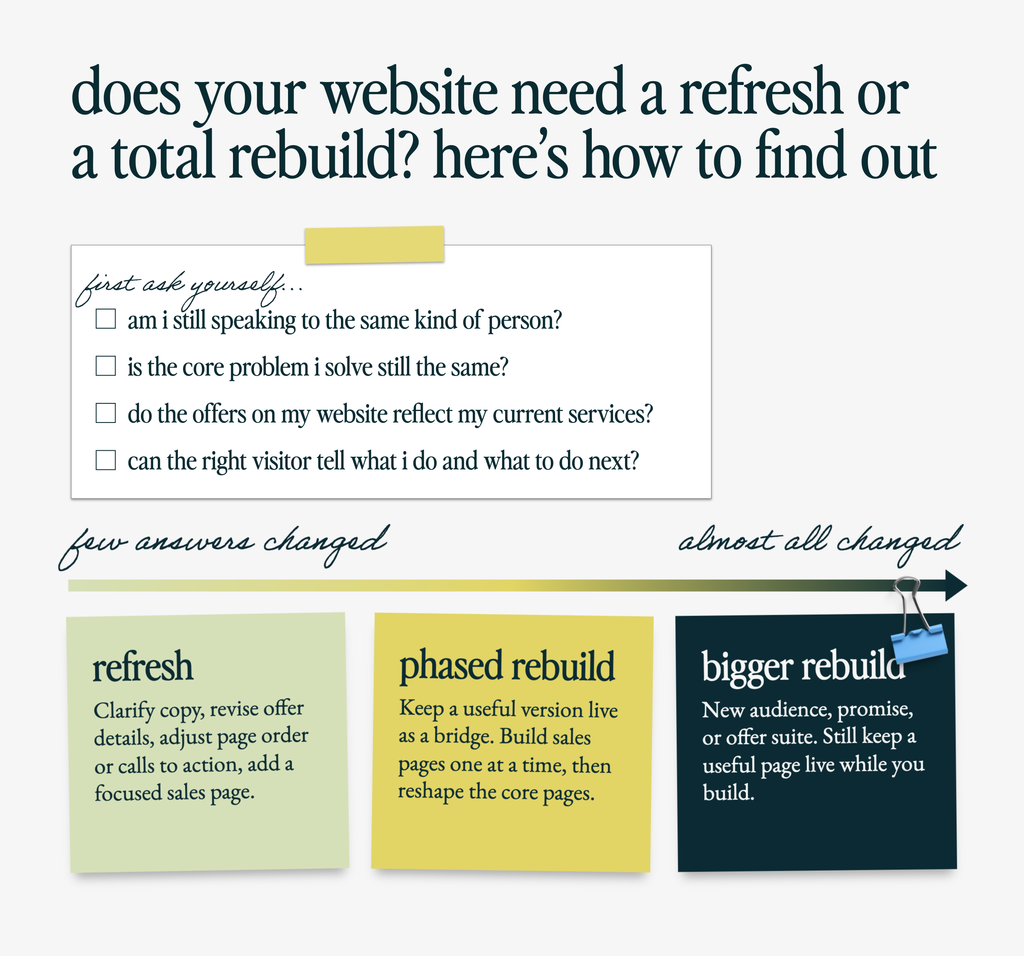
Website refresh vs. rebuild: which one do you need?
Whether you need a website refresh, a phased rebuild, or a full rebuild depends on how much your positioning is changing. A website can feel outdated without your positioning being wrong—and a meaningful positioning shift doesn’t automatically mean the whole site needs to disappear.
Before you decide, ask yourself:
- Am I still speaking to the same kind of person?
- Is the core problem I solve—and the change I help create—still the same?
- Are my offers still right for the business, even if they need clearer descriptions or new sales pages?
- Does my site still make it easy for the right visitor to understand what I do and what to do next?
If most of those are still yes: You probably don’t need to burn the whole thing down. Update what’s out of date: clarify the copy, revise offer details, adjust page order or calls to action, and add a focused sales page for a new offer.
If some answers have changed: You may need more than a surface refresh, but you can still work in phases. Keep an accurate, useful version online as a bridge while you reposition and test your offers. Build sales pages one at a time, then reshape the core pages around the offers you know you want to keep.
If almost all of them have changed: Your audience, core promise, offer suite, or path to work with you may be fundamentally different. A bigger rebuild could make sense—especially if the current site tells the wrong story or makes the new customer journey confusing. But a full rebuild doesn’t mean you have to go dark while you work. Keep a useful page live while you build, and decide what to do with older pages as part of the plan.
For me, the positioning shift was big enough that I did need to rebuild my custom core pages eventually. The mistake wasn’t recognizing that my old site no longer fit. It was panicking, taking it all offline, and trying to solve the positioning, offer pages, homepage, services page, and design in one big project.
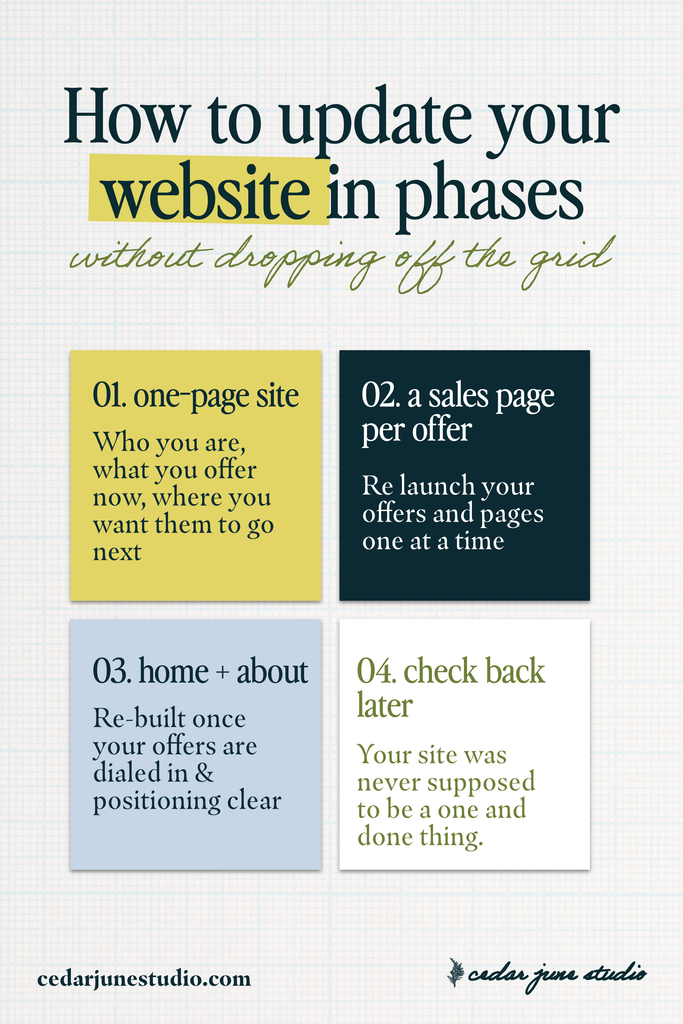
How to update your website in phases (without going offline)
1. Keep a useful one-page site live while you reposition
While I repositioned my offers, a clear one-page site could have kept the essentials online: who I am, what I offer right now, and where to go next. It wouldn’t need to be the final custom homepage and services page; I could build those once my offers were dialed in. We made the same call for Kath during her Studio Session: we decided together that a one-page website was the best fit for her, and I built it during her Studio Day.
Kath’s one-page site gives her a clear online home while she continues refining her offers.
Here’s a quick walkthrough of how my one-page site was structured.
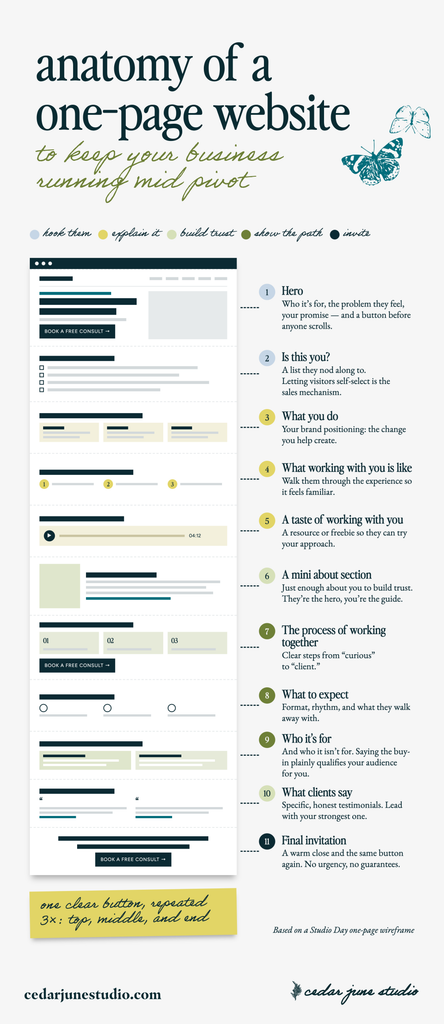
2. Let your offers guide the next update
I launched a few offers in sequence—the 2D Brand Design Masterclass, then Brand Brushstrokes—and each one helped me learn what my audience wanted and what my site needed to explain.
Instead of waiting to redesign the whole website, I could have launched a dedicated sales page for each offer as it was ready. Those pages would have supported each launch and helped me dial in the offers before I built the core pages (like home and about) around them.
3. Build the custom homepage and services page once your offers are dialed in
Once the offers were clear, I could have brought them together in a custom homepage and services page. That way, I’d be building those core pages around offers that were already dialed in, instead of trying to make every decision—positioning, sales pages, site structure, and design—all at once. When I first wrote this, I was trying to build four sales pages at the same time. Staggering that work, then building the core pages, would have saved time and heartache.
4. Choose the next update based on what your business needs now
That might mean refreshing your homepage copy, adding a section for a new service, making your calls to action clearer, or updating colors and fonts. You can work through those changes in a sequence that fits your priorities and capacity.
Phased updates aren’t about patching things together randomly. They’re about making intentional decisions in the right order, instead of putting pressure on yourself to perfect the whole site in one go.
You don’t have to redesign your whole website at once
If your website has been sitting on the back burner because rebuilding the whole thing feels overwhelming, try asking a smaller question: What’s the next best update for where my business is right now?
If your website needs a thoughtful next step, start with a Studio Session. It’s a focused website review: we’ll look at what’s working, what’s confusing, and which phased updates to prioritize. You’ll leave with a clear action plan—not the assumption that you need to rebuild everything. Book a Studio Session.
Want hands-on help carrying out that plan? You can add on a Studio Day, and we’ll work through phased website edits together—one focused set of updates at a time, without turning it into a full rebuild. A rebuild can still make sense when the site truly needs one, but it doesn’t have to be the default answer.
Your website doesn’t have to do everything on day one. It just needs to support where your business is now—and leave room for what comes next.
October 21, 2026


behind the brand
Behind The Brand is a weekly newsletter for solopreneurs and small business owners navigating the ongoing reality that their brand needs to evolve—whether they’re working with a DIY setup, in the middle of a rebrand, or maintaining an established brand through business pivots.
whether you're working with a DIY setup, in the middle of a rebrand, or managing an established brand through business pivots. If you love learning about the why behind brand design and want practical, actionable strategies to help you own your personal brand and feel confident marketing it—because you understand not just the what, but the how and why—then this is for you.


The Cedar June Brand Color Kit
PDF guide, canva template & tutorial
your brand.
2d Design Masterclass
learn the design basics that will help you make the most of your brand id & save time in canva
your brand.


Chief Creative Officer Week FREE framework
get more done for your brand in 5 days than you have in the last 5 months
Whether you're launching, rebranding, pivoting, or just ready to finally love your brand—here's how we can create something that celebrates who you really are while strategically growing your business.

Not sure where to start?
Book a disco call (that’s discovery call, but more fun) and we’ll figure out what makes sense for where you are right now.


Studio Sessions: WEEK LONG REBRAND STRATEGY SPRINTS
Perfect when you need strategic guidance on what's next. Sometimes you just need to brain-dump your brand overwhelm with someone who gets it. In 60 minutes, we'll tackle whatever brand challenge is top of mind—from website strategy to visual direction to figuring out your next pivot. You'll walk away with a clear strategy and the confidence to move forward.

Brand Brushstrokes: Custom Brand Identity + Illustrations

For when you’re ready to show up as your whole, multifaceted self. Stop second-guessing every design decision and get a comprehensive brand package that marries your personal and professional sides. Through custom illustrations and strategic brand development, we’ll create a one-of-a-kind, instantly recognizable brand and the guidelines you need to actually use it.


The Signature Site: Custom Website Design Through Visual Storytelling
When your business has outgrown your website. This done-for-you website design takes you from strategy through site launch. Together we build a website that screams you—where the visual story works with your copy and content, creating a site so aligned it’s like you put your signature on it.
Brand & web design services
BRAND COLOR KIT
BRAND & DESIGN BASICS
BRAND IDENTITY
ILLUSTRATIONS & ICONS
BRAND PIVOT STRATEGY
WEBSITE & SALES PAGE DESIGN

