


How to Understand Your Target Audience—Without Making Up an Ideal Client

This blog is dedicated to helping you make sense of all those fluffy marketing terms you hear on Instagram and figure out what they actually mean for your business. Step-by-step guides, platform breakdowns, client case studies, and deep dives into the stuff that actually helps you grow.
XO Catie
Audience research isn’t about inventing the perfect customer. It’s about gathering evidence from real people so you can make better decisions about your brand.
You have an idea for a new offer, a brand pivot, or a different direction you want to take your business. And you’re tempted to build the whole thing before talking to anyone.
You can picture the perfect person for it. You know what they need, what they’re struggling with, and why your offer is exactly what they’ve been waiting for.
But how much of that do you know—and how much are you guessing?
Audience research is the bridge between what you want to create and how it can serve real people. It isn’t about inventing an ideal client and then looking for evidence to back up your assumptions. It’s about paying attention to what people already do, say, ask, buy, and come back fo
This guide shows you how to do audience research through six practical steps, so you can make clearer decisions about your messaging, offers, content, and positioning.
And it’s not a one-and-done task. Your audience, your business, and the things you’re trying to learn will change over time.

1. Start with what you need to learn about your target audience
Before you start collecting data, get clear on the decision you’re trying to make. Otherwise, you can end up with a pile of information and still feel just as stuck.
Maybe you’re trying to decide whether to create an offer, update your messaging, or focus on a different audience. Start there, then ask questions that will help you make that decision:
- Who needs the offer I’m creating?
- What problem are they trying to solve?
- What have they already tried?
- What outcome do they actually want?
- What’s confusing them about my brand or services?
If you’re building something for a new audience, remember that your current followers aren’t automatically the people that offer is for. You may need to learn about people who aren’t already in your community, too.
2. Use audience research methods to understand what people actually do
Your audience leaves clues in their behavior. Look at what’s already happening across your business:
- Which pages people visit on your website.
- Which emails they click on or reply to.
- Which content gets saved, shared, or thoughtful responses.
- Which services people book repeatedly.
- Which products they reorder.
These signals don’t all mean the same thing. The people who engage with a piece of content may not be the same people who pay for your work. Likes can tell you that an idea caught someone’s attention; repeat bookings and purchases can tell you something different.
Summer, an esthetician I worked with, had been exploring an offer that combined personalized skincare with nervous-system support, guided inner work, and progressive care. After she ran it, she realized that delivering the experience was taking more time than she wanted it to.
We looked at what clients already booked and bought, what they returned for, and what they valued about working with her. Her paying clients wanted visible results, expert guidance, and restoration—but they didn’t necessarily want those things packaged as a separate spiritual offer.
That information changed the question. Instead of asking, “What new offer should I add?” we could look at how to deepen what was already working.
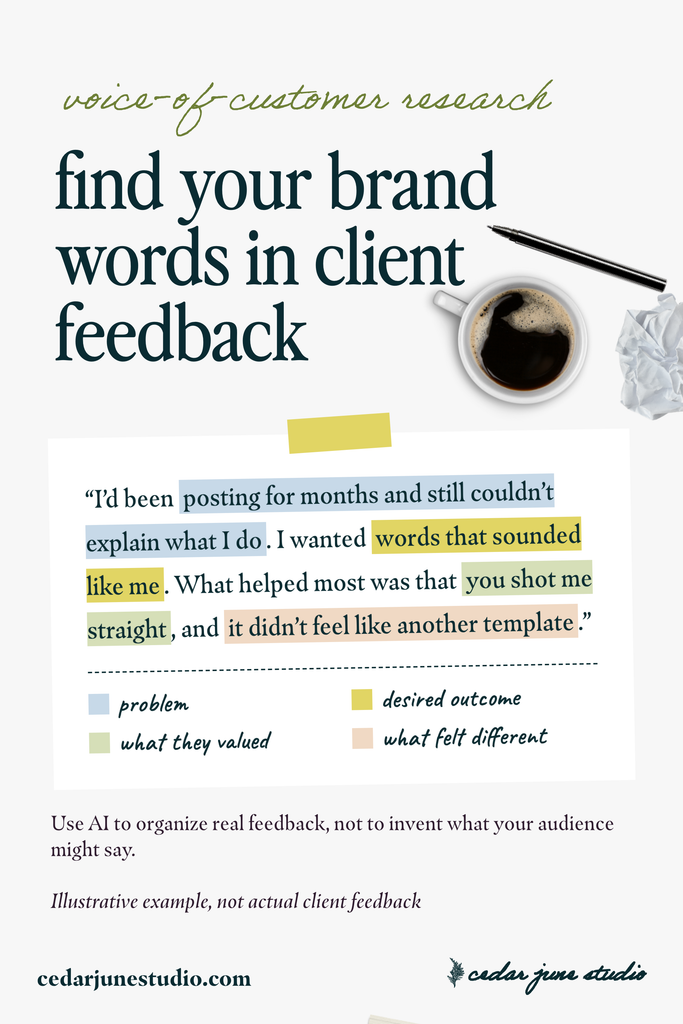
3. Mine customer feedback for voice-of-customer language
Your clients may already have the language you’re trying to find. This is the heart of voice-of-customer research: listening to the words people use to describe their problems, needs, and experience. Bring your testimonials, feedback forms, and relevant client messages together in one document. Then look for patterns:
- How do clients describe the problem they had?
- What words do they use for the outcome?
- What do they value most about working with you?
- What do they say makes your approach different?
You can print the feedback and highlight the phrases that stand out, or use AI to help you spot repeated language in the material you provide. Either way, the words should come from actual feedback—not from a tool guessing what your clients might say.
When I did this with my own client feedback, people kept saying I “shoot them straight.” That phrase helped me see what clients valued about Studio Sessions, and it informed how I talked about the offer.
And when you ask someone for feedback, don’t just ask for a testimonial. Ask what problem they were trying to solve and what felt different about your solution. That gives you more to learn from than a general “I loved working with you.”
4. Use customer interviews and social listening to hear from real people
Numbers and written feedback can only tell you so much. Sometimes you need to talk to people directly.
Invite someone to a research call and explain what you’re trying to learn. Ask about their experience, what they’ve already tried, what they’re still figuring out, and what outcome they’re hoping for. You’re not there to pitch an offer or convince them your idea is right. You’re there to listen.
Social listening gives you another way to learn: pay attention to conversations happening outside your own audience. Read relevant discussions, comments, and forums. Notice which questions and frustrations come up repeatedly. AI-assisted search can help you find places to start, but follow the sources and investigate for yourself.
AI can help you explore and organize research. It doesn’t replace real people validating an idea.
5. Treat your content as an audience research experiment
Content can help you learn what people respond to—but only if you give yourself something specific to look for.
Try this:
- Choose one idea or question to test.
- Create a short series of three to five pieces around it.
- Invite responses through captions, polls, or email questions.
- Review what people said and did.
Pay attention to replies and thoughtful questions, as well as saves, shares, and clicks. Treat those as signals to investigate—not proof that people will buy.
I’ve used this approach in my own brand, too. Interest and feedback from one Instagram story and a thread helped me rethink how I differentiated my identity offer around illustrations. It gave me something real to consider instead of asking myself to come up with the answer in a vacuum.
6. Turn audience research into clearer brand messaging, positioning, and offers
Research isn’t finished when you’ve gathered information. The next step is deciding what it might change.
Understanding your audience can help you explain your offer in language they recognize, bring the benefits they value into your positioning, and create content that answers their questions. Those decisions can affect whether the right people take action—but research alone doesn’t guarantee better conversion. Choose a change, test it, and see what happens.
| What you learn | What it could change |
|---|---|
| People repeatedly use the same words to describe a problem | Website copy and content hooks |
| Clients want a particular outcome | Offer positioning and benefits |
| People are confused about your services | Messaging and how you explain your work |
| Clients repeatedly book or buy the same thing | What to deepen before adding something new |
| People engage in one place and take action in another | Channel and content priorities |
Look for patterns across more than one source. If clients describe the same problem in conversations and feedback, that’s more useful than a single comment on a post. If people engage with an idea but don’t take the next step, that may be a reason to ask more questions—not to assume you know what’s missing.
You’re trying to connect the dots between what people say, what they do, and what you want to build.
Audience research is a practice, not a box to check
You don’t need to research every possible thing about your audience before you take a step. Start with one question. Gather evidence from a few different sources. Decide on one thing to test.
Then keep learning as your business and audience evolve. A quarterly check-in can help you notice what’s working, what’s changed, and what you want to investigate next.
Want a place to gather what you’re learning? Use my audience research template to organize your notes, work through the questions your research needs to answer, and use the included AI prompts to look for patterns and gaps in the evidence you’ve collected.
→ Get the Audience Research Template (with AI prompts)
And if you’ve gathered the information but you’re too close to it to see what it means, that’s the kind of work we can do together in a Studio Session.
→ Learn More about The Studio Session
October 16, 2026


behind the brand
Behind The Brand is a weekly newsletter for solopreneurs and small business owners navigating the ongoing reality that their brand needs to evolve—whether they’re working with a DIY setup, in the middle of a rebrand, or maintaining an established brand through business pivots.
whether you're working with a DIY setup, in the middle of a rebrand, or managing an established brand through business pivots. If you love learning about the why behind brand design and want practical, actionable strategies to help you own your personal brand and feel confident marketing it—because you understand not just the what, but the how and why—then this is for you.


The Cedar June Brand Color Kit
PDF guide, canva template & tutorial
your brand.
2d Design Masterclass
learn the design basics that will help you make the most of your brand id & save time in canva
your brand.


Chief Creative Officer Week FREE framework
get more done for your brand in 5 days than you have in the last 5 months
Whether you're launching, rebranding, pivoting, or just ready to finally love your brand—here's how we can create something that celebrates who you really are while strategically growing your business.

Not sure where to start?
Book a disco call (that’s discovery call, but more fun) and we’ll figure out what makes sense for where you are right now.


Studio Sessions: WEEK LONG REBRAND STRATEGY SPRINTS
Perfect when you need strategic guidance on what's next. Sometimes you just need to brain-dump your brand overwhelm with someone who gets it. In 60 minutes, we'll tackle whatever brand challenge is top of mind—from website strategy to visual direction to figuring out your next pivot. You'll walk away with a clear strategy and the confidence to move forward.

Brand Brushstrokes: Custom Brand Identity + Illustrations

For when you’re ready to show up as your whole, multifaceted self. Stop second-guessing every design decision and get a comprehensive brand package that marries your personal and professional sides. Through custom illustrations and strategic brand development, we’ll create a one-of-a-kind, instantly recognizable brand and the guidelines you need to actually use it.


The Signature Site: Custom Website Design Through Visual Storytelling
When your business has outgrown your website. This done-for-you website design takes you from strategy through site launch. Together we build a website that screams you—where the visual story works with your copy and content, creating a site so aligned it’s like you put your signature on it.
Brand & web design services
BRAND COLOR KIT
BRAND & DESIGN BASICS
BRAND IDENTITY
ILLUSTRATIONS & ICONS
BRAND PIVOT STRATEGY
WEBSITE & SALES PAGE DESIGN

