


How to Create a Brand Newsletter: Strategy, Format & Design

This blog is dedicated to helping you make sense of all those fluffy marketing terms you hear on Instagram and figure out what they actually mean for your business. Step-by-step guides, platform breakdowns, client case studies, and deep dives into the stuff that actually helps you grow.
XO Catie
A newsletter isn’t just another place to put your logo. And it shouldn’t require reinventing your entire brand every time you sit down to send one.
Behind the scenes, I talk to a lot of business owners who:
- Have an email list—sometimes thousands of people—they aren’t actually sending anything to
- Built a list from ads or a freebie, then never followed up after the download & automated funnel their business coach told them they had to have.
- Email their list here and there, without a set format or a clear sense of what a newsletter is supposed to do
- Use different colors, fonts, and branding on every email they send
If any of that sounds familiar—or your newsletter keeps getting pushed to the bottom of your to-do list—start here.
What is a brand newsletter—and how is it different from a sales email?
A brand newsletter is a recurring publication that gives a specific audience a reason to keep hearing from your business. It might teach, share a perspective, curate useful resources, help readers make better decisions and ideally all of the above.
First things first, because I swear this trips up more of my clients than almost anything else: just sending your list an email from Flodesk or ConvertKit doesn’t make it a newsletter.
Here’s the distinction I use when planning an email strategy:
- A sales email centers on an offer and asks the reader to take a buying-related action.
- A newsletter centers on ongoing value and the relationship with the reader.
- A welcome or delivery sequence introduces your brand, delivers something someone requested, or helps them take their next step.
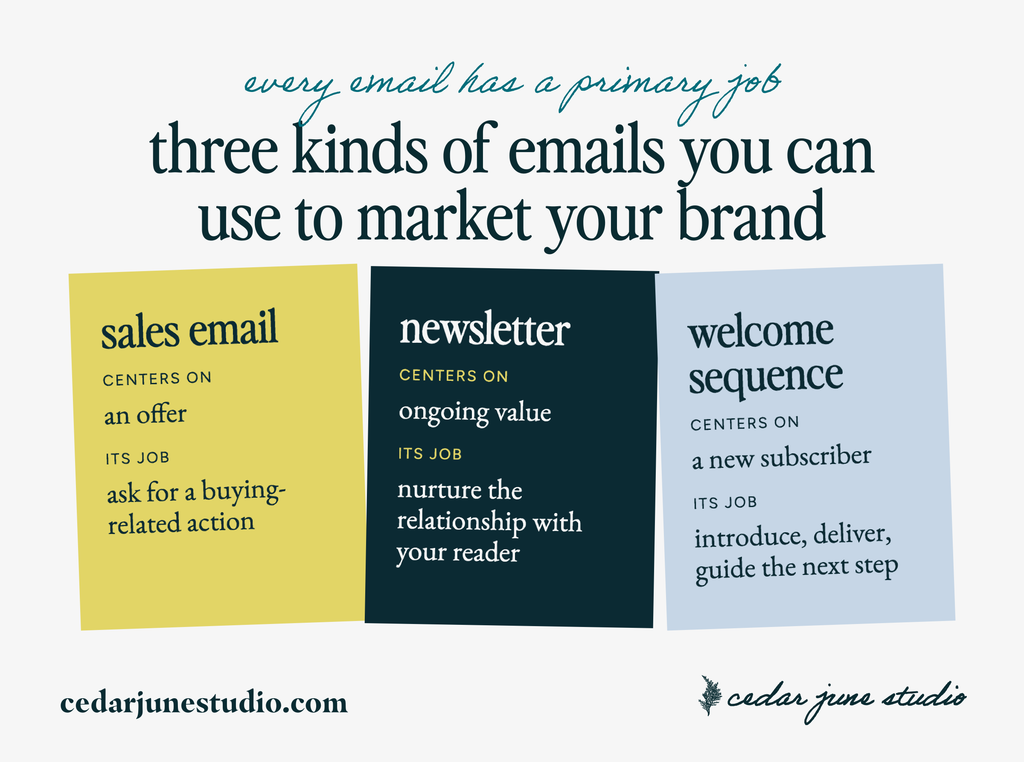
You can sell in a newsletter. You can teach in a sales email. The important thing is knowing the primary job of the email you’re writing.
Now, before you go stressing that you need all of these things—you don’t.
I repeat: you do not need every possible sequence in place to send a newsletter.
1. Decide whether a newsletter makes sense for your brand & audience
Having an email list is not, by itself, a reason to start a weekly publication in the form of a branded newsletter.
Ask yourself:
- What will these people continue to care about after the reason they first subscribed?
- Is there a recurring problem, interest, or ambition I can help with?
- How does that ongoing conversation connect to my business?
- Can I sustain the format and frequency I’m considering?
Take my own wedding photographer. I’m on her email list, and she’s sent a few genuinely helpful things—a guide, a list of available add-ons. A welcome sequence makes total sense there. So would the occasional email about album discounts.
But a weekly newsletter full of wedding planning advice? Nice for a few months. Once my wedding has passed, I’d have very little use for it—and like most people, I’d probably unsubscribe.
That doesn’t make email marketing as a whole a bad fit for her. It means she’d need to decide who an ongoing publication is actually for: couples in the middle of planning, past clients with new photography needs, or a different audience entirely—like other photographers, if she ever pivoted into education.
Those are different newsletters with different promises.
Choose the relationship you want to nurture before choosing whether or not your brand needs a newsletter.
2. Position your newsletter as its own offer
Even when it’s free, your newsletter asks for something valuable: someone’s attention (and a spot in their inbox, for that matter).
I don’t know about you, but my inbox is fuller than ever—and I’ve been hitting unsubscribe more than ever, too.
On the flip side if I know a newsletter has valuable info I am interested in, and I’m going to walk away with something useful? I’ll save that sucker for ten days until I can get around to reading it.
No matter how long it is.
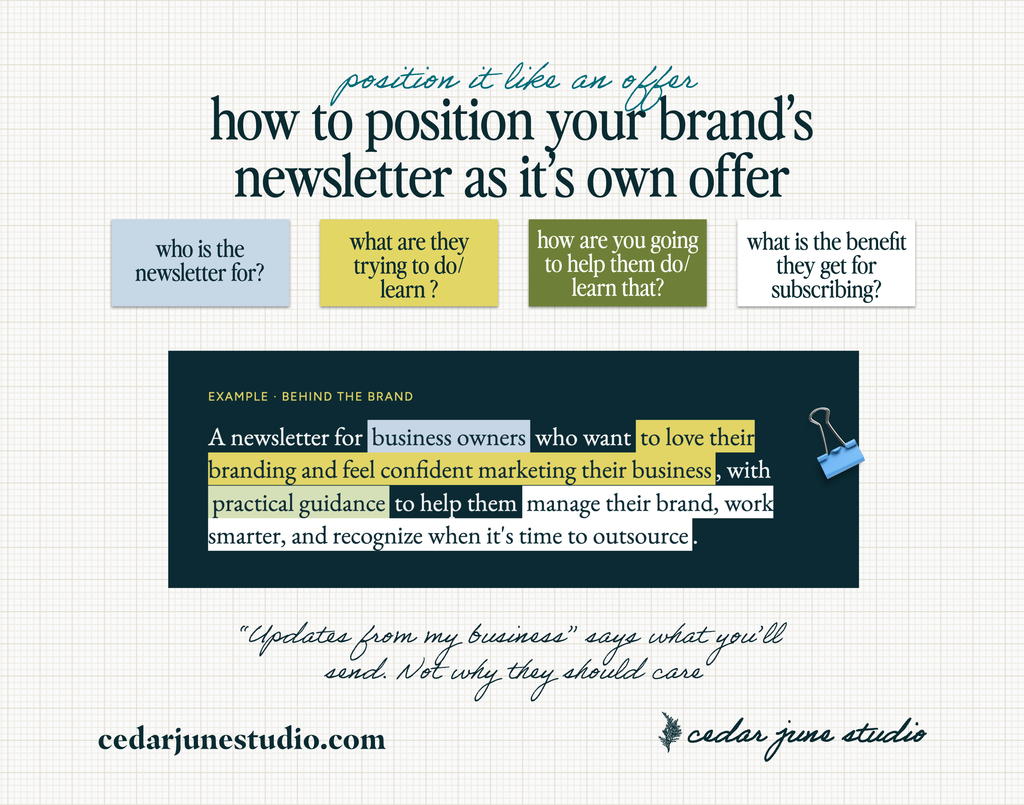
How to become a “save for later” newsletter in someone else’s inbox
Start with three decisions.
Who it’s for.
Go beyond a broad label like “business owners.”
- What are these readers trying to do?
- What feels confusing?
- What do they want to understand or handle more confidently?
Need to get to know your audience better? Click here to download my free research template
What will you call it?
A name gives your weekly newsletter an identity you can refer to in your content and conversations.
It makes it it’s own offer and something that your audience builds recognition around. If you already know what something is – when you see and identify the name of it in your inbox – think about how much more likely you are to want to read and not just delete.
What will they get out of it?
Don’t ask the name to do all the explaining. Pair it with a clear description of who it’s for and what readers can expect.
“Updates from my business” describes what you’ll send. It doesn’t necessarily explain why someone should care.
Try this positioning sentence:
A newsletter for [specific reader] who wants [desired progress], with [kind of help] they can use to [practical benefit].
For example, here’s how I’d describe my Behind the Brand newsletter:
A newsletter for business owners who want to evolve a brand that looks, feels, and sounds like them, with real brand breakdowns and slow-branding frameworks they can use to make confident decisions about what their brand needs next.
How to create a brand newsletter based on how you communicate
I talk to a lot of founders about their newsletters. And I see the same thing over and over. The same thing I used to do myself. We see a newsletter format from a peer – and try to tranlate our own ideas in that same format.
You like how so and so has this section so now you think your newsletter needs the same – but does it make sense for you are sending? For your audience? For the conversation you are having with the reader?
If trying to share your own ideas in someone else’s format is making it harder to be consistent and get your ideas out – try this exercise.
Imagine you’re walking into your favorite coffee shop to meet a new business friend. Not the friend who gets your 4 a.m. texts and GIF-only replies—someone you’d like to get to know better.
They have a problem you know exactly how to help them solve.
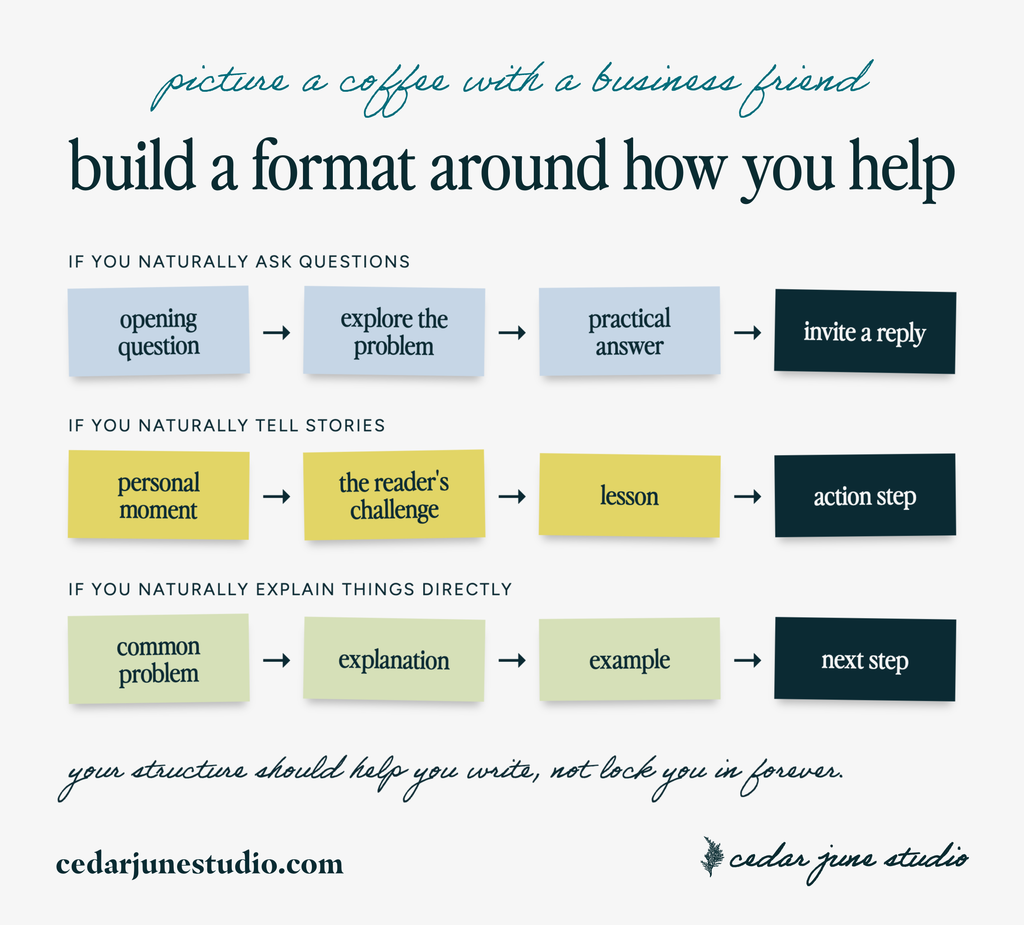
How do you start that conversation? Dive into a story? Catch up on life for a minute? Ask a few questions? Get straight to the problem and sketch out a solution? There’s no right or wrong answer—just notice what you’d actually do.
That instinct can help you build a repeatable format.
For example:
| If you naturally… | Try this newsletter structure |
|---|---|
| Ask questions | Opening question → explore the problem → practical answer → invitation to respond |
| Tell stories | Personal moment → connection to the reader’s challenge → lesson → action step |
| Explain things directly | Common problem → explanation → example → next step |
When I took a Studio Session client, Devon, through this exercise, she shared that she liked to start conversations by asking questions. That gave us a starting point for her newsletter introductions: a question, rather than a format borrowed from someone else.
Building your format around how you communicate—instead of what most people (myself included) tend to default to—is how you stop boxing yourself in creatively.
Your structure should help you write. It doesn’t need to lock you into the exact same kind of opening forever.
4. Choose a newsletter frequency you can support
For one Studio Session client—a functional nutritionist—the problem wasn’t a lack of ideas. Tori’s newsletters only went out seasonally, which wasn’t often enough to build trust, and short-form social never felt like her. Her real strength was long-form writing.
Her readers were in a slow burn: noticing problems, but not ready to book help yet. So the newsletter’s job wasn’t to convert every week. It was to build trust, so she’d be the first name they thought of when they were ready.
Instead of forcing a format that didn’t fit, we built a rhythm around it: one long-form deep dive each month, repurposed into four weekly newsletters, with social content as the last stop in the repurposing chain—not the starting point.
On the other hand – my weekly newsletter naturally feels like the first stop in my creative process. So that is the new content I am writing each week. Then I combine and repurpose that content into Substack articles (which I also write from scratch when it feels right) and blog posts, and if I really feel like it. Instagram content.
5. Give your newsletter colors specific jobs
Now we can talk about what it looks like.
First, you need a brand color scheme you know how to implement. Keyword: implement.
I try not to smack-talk other designers (there’s plenty of room for all of us), but if there’s one thing I see all the time in the brand kits clients send me, it’s colors that look great on paper and only work in a couple of combinations in real life/ on the screen. One or two usable backgrounds. One decent text color. And a handful of others you have no idea what to do with.
So you end up adding colors in willy-nilly every time you design something, just to keep it from feeling so blah—and burning time clicking around a color picker.
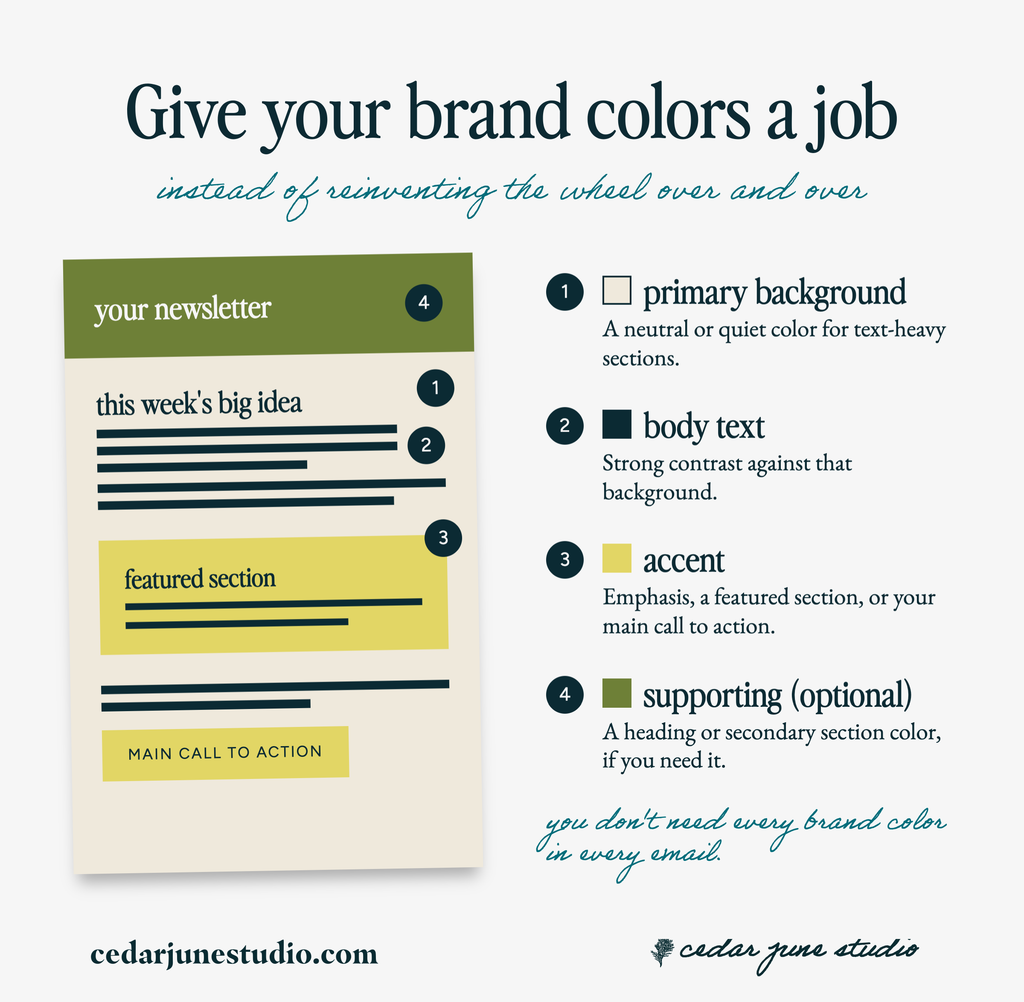
Instead, give a few colors consistent jobs:
- Primary neutral: A quiet background for text-heavy sections. For Cedar June, that’s Cascade—an off-white that’s honestly not all that groundbreaking, which is exactly why it works.
- Body text: A color with strong contrast against that background. Mine is called Alger.
- Accent: A high-key pop of color for a featured section or your main call-to-action button.
- Optional supporting color: A heading or secondary section color that acts as a visual speed bump—it slows the skimmer down and helps their brain register a new section.
You don’t need to use every color in your brand palette in every email.
Save those colors in your email platform and document which one goes where.
And pro tip: name your colors. Even if you’re totally solopreneuring life right now, it’ll come in handy the moment you hire someone to help with literally anything—instead of asking them to change it to “the darker hot pink one.”
The goal is to stop making the same design decisions from scratch every week. That just wastes your time and energy.
6. Choose readable fonts—not a perfect replica of your logo
Your newsletter’s body copy needs to be easy and accible to read. It doesn’t need to use the most decorative font in your brand kit.
Start with a simple heading-and-body pairing. If your exact brand fonts aren’t available in your email platform, look for supported alternatives with a similar feel:
- Serif: Letterforms with finishing strokes, often used for a more editorial or traditional feel.
- Sans serif: Letterforms without those finishing strokes, often used for a cleaner or more minimal feel.
- Decorative: More expressive fonts—think handwritten scripts or funky, blocky logo type—better reserved for short headings or your newsletter logo. No one wants to read a paragraph of decorative font, much less three lines of it.
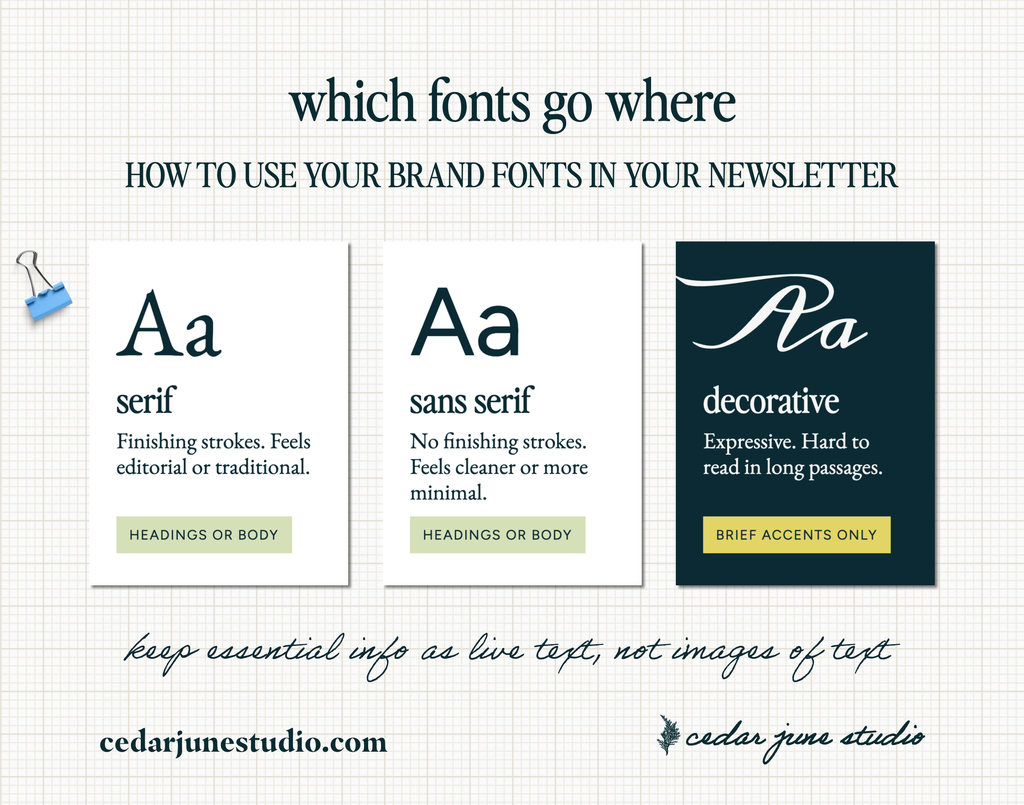
Neither serif nor sans serif is automatically the right answer. Look at the actual font, size, spacing, and contrast in the email you’re sending.
Keep essential information as live text rather than turning whole sections into images just to preserve a particular typeface.
When I send a newsletter, readers were looking at body copy set in New York—a font available in my email platform—instead of my actual brand paragraph font, Masquerlo. I promise that none of my readers have thought too much about it much less cared.
I break this down in detail & help you choose and combine brand fonts in the 2D design masterclass
7. Build one reusable newsletter template
Once the strategy, format, colors, and fonts are decided, build a simple template around them.
Start with:
- A recognizable newsletter name or header.
- An opening section that fits how you communicate.
- A main value section with a clear idea and useful subheadings.
- A practical takeaway or next step.
- A closing invitation that makes sense for that issue.
Give paragraphs room to breathe. This is not highschool english class. You don’t have to have 4 sentances to make a paragraph. Shorter, with more line breaks are easier for people to scan and read.
Use headings to make longer pieces navigable. Add images to explain or demonstrate.
Before sending, preview the email on a phone, send yourself a test, and check your links.
When I audit a client’s newsletter in a Studio Session, the design recommendations are often simpler than people expect. For one client, it came down to a branded header with issue numbers, her own real photos instead of stock images, branded section dividers, a little more of her brand color, and a “Forwarded this? Subscribe here” note.
You don’t have to earn the right to send a useful newsletter by designing the fanciest one.
And if the tech side is what’s slowing you down, you’re not alone—it was the main hang-up Devon mentioned after our session, too. I figure I could tell you how to build it, or I could show you. Watch my Flodesk newsletter template tutorial or ConvertKit newsletter template tutorial.
Your brand newsletter planning checklist
Before you open a blank email, make sure you can finish these sentences:
- This newsletter is for…
- People will keep reading because…
- The main job of this newsletter in my business is…
- My repeatable format is…
- My starting send frequency is…
- My background, text, and accent colors are…
- My heading and body fonts are…
- The useful thing readers will leave this issue with is…
Frequently asked questions about creating a brand newsletter
Can I sell in my newsletter?
Yes. A relevant offer can be a natural next step. The distinction is whether the issue delivers the value readers signed up for, rather than using that promise only as a lead-in to a pitch.
Do I need a custom newsletter design?
Not necessarily. A simple template with a clear structure, readable text, and consistent brand elements is a useful place to start. Add custom design elements when they serve a purpose.
What if my newsletter doesn’t sound like the ones I subscribe to?
That isn’t automatically a problem. Evaluate whether your reader understands the idea, gets something useful, and knows what to do next. Someone else’s voice isn’t the standard yours has to meet.
Create a newsletter people have a reason to keep reading
The goal isn’t to add “send newsletter” to your list of things you feel behind on.
It’s to create a recognizable, valuable part of your brand—one that serves your audience and gives you a sustainable way to stay connected.
Start with the promise. Build a format you can actually use. Then let the design support the conversation.
For more practical guidance on building and managing a brand that feels like you, subscribe to my newsletter.
October 30, 2026


behind the brand
Behind The Brand is a weekly newsletter for solopreneurs and small business owners navigating the ongoing reality that their brand needs to evolve—whether they’re working with a DIY setup, in the middle of a rebrand, or maintaining an established brand through business pivots.
whether you're working with a DIY setup, in the middle of a rebrand, or managing an established brand through business pivots. If you love learning about the why behind brand design and want practical, actionable strategies to help you own your personal brand and feel confident marketing it—because you understand not just the what, but the how and why—then this is for you.


The Cedar June Brand Color Kit
PDF guide, canva template & tutorial
your brand.
2d Design Masterclass
learn the design basics that will help you make the most of your brand id & save time in canva
your brand.


Chief Creative Officer Week FREE framework
get more done for your brand in 5 days than you have in the last 5 months
Whether you're launching, rebranding, pivoting, or just ready to finally love your brand—here's how we can create something that celebrates who you really are while strategically growing your business.

Not sure where to start?
Book a disco call (that’s discovery call, but more fun) and we’ll figure out what makes sense for where you are right now.


Studio Sessions: WEEK LONG REBRAND STRATEGY SPRINTS
Perfect when you need strategic guidance on what's next. Sometimes you just need to brain-dump your brand overwhelm with someone who gets it. In 60 minutes, we'll tackle whatever brand challenge is top of mind—from website strategy to visual direction to figuring out your next pivot. You'll walk away with a clear strategy and the confidence to move forward.

Brand Brushstrokes: Custom Brand Identity + Illustrations

For when you’re ready to show up as your whole, multifaceted self. Stop second-guessing every design decision and get a comprehensive brand package that marries your personal and professional sides. Through custom illustrations and strategic brand development, we’ll create a one-of-a-kind, instantly recognizable brand and the guidelines you need to actually use it.


The Signature Site: Custom Website Design Through Visual Storytelling
When your business has outgrown your website. This done-for-you website design takes you from strategy through site launch. Together we build a website that screams you—where the visual story works with your copy and content, creating a site so aligned it’s like you put your signature on it.
Brand & web design services
BRAND COLOR KIT
BRAND & DESIGN BASICS
BRAND IDENTITY
ILLUSTRATIONS & ICONS
BRAND PIVOT STRATEGY
WEBSITE & SALES PAGE DESIGN

